Mohs Resident
Surgery days begin at 7 am. Residents are responsible for primary assessment of the patient, preparation of the patient for surgery, assisting and performing surgeries and completing the medical records including the surgical operation notes for the patients in whom they were involved in their care. The residents are assisted by the Mohs staff, including the micrographic surgery and dermatologic oncology fellow, medical assistants, nurses, and faculty. There are templates provided to assist in data collection, but do not prohibit the resident from additional documentation that is required for a complete medical note. Melanoma conference is coordinated by the Mohs resident and fellow and occurs on the third Thursday of each month. In coordinating this conference, the resident is responsible for providing a list of patients to the Mohs histology technician who will assist in obtaining slides and to the Program Coordinator who will finalize the list for distribution to the attendees. The resident is also responsible for contacting pathology ten days prior to the conference to confirm the patient list, for generating copies of the patient list and staging sheet for distribution to conference attendees, for organizing a presentation of the patients, for sending update letters to referring physicians, and completing the index conference tumor registry data forms and sending them to the appropriate administrative staff member.
Text from this document (searchable)
Page 1
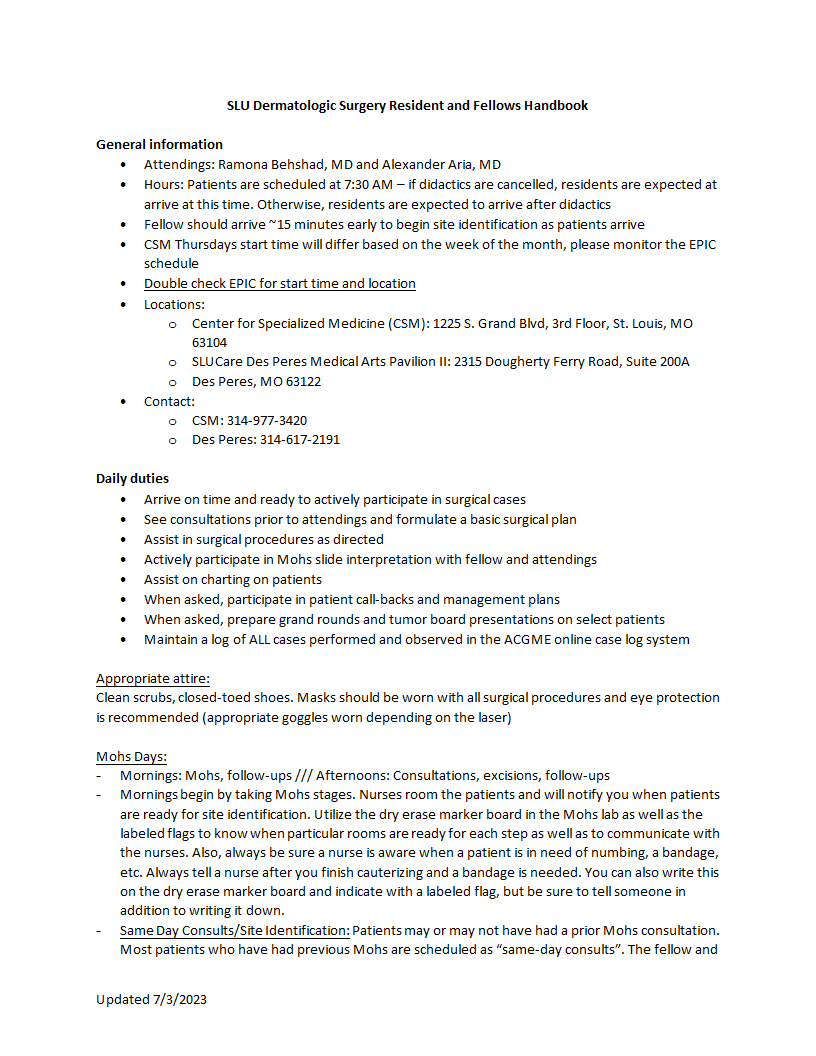
SLU Dermatologic Surgery Resident and Fellows Handbook
General information
• Attendings: Ramona Behshad, MD and Alexander Aria, MD
• Hours: Patients are scheduled at 7:30 AM - if didactics are cancelled, residents are expected at
arrive at this time. Otherwise, residents are expected to arrive after didactics
• Fellow should arrive ~15 minutes early to begin site identification as patients arrive
• CSM Thursdays start time will differ based on the week of the month, please monitor the EPIC
schedule
• Double check EPIC for start time and location
• Locations:
• Center for Specialized Medicine (CSM): 1225 S. Grand Blvd, 3rd Floor, St. Louis, MO
63104
• SLUCare Des Peres Medical Arts Pavilion II: 2315 Dougherty Ferry Road, Suite 200A
• Des Peres, MO 63122
• Contact:
• CSM: 314-977-3420
• Des Peres: 314-617-2191
Daily duties
• Arrive on time and ready to actively participate in surgical cases
• See consultations prior to attendings and formulate a basic surgical plan
• Assist in surgical procedures as directed
• Actively participate in Mohs slide interpretation with fellow and attendings
• Assist on charting on patients
• When asked, participate in patient call-backs and management plans
• When asked, prepare grand rounds and tumor board presentations on select patients
• Maintain a log of ALL cases performed and observed in the ACME online case log system
Appropriate attire:
Clean scrubs, closed-toed shoes. Masks should be worn with all surgical procedures and eye protection
is recommended (appropriate goggles worn depending on the laser)
Mohs Days:
- Mornings: Mohs, follow-ups /// Afternoons: Consultations, excisions, follow-ups
- Mornings begin by taking Mohs stages. Nurses room the patients and will notify you when patients
are ready for site identification. Utilize the dry erase marker board in the Mohs lab as well as the
labeled flags to know when particular rooms are ready for each step as well as to communicate with
the nurses. Also, always be sure a nurse is aware when a patient is in need of numbing, a bandage,
etc. Always tell a nurse after you finish cauterizing and a bandage is needed. You can also write this
on the dry erase marker board and indicate with a labeled flag, but be sure to tell someone in
addition to writing it down.
Same Day Consults/Site Identification: Patients may or may not have had a prior Mohs consultation.
Most patients who have had previous Mohs are scheduled as “same-day consults”. The fellow and
Updated 7/3/2023
Page 2
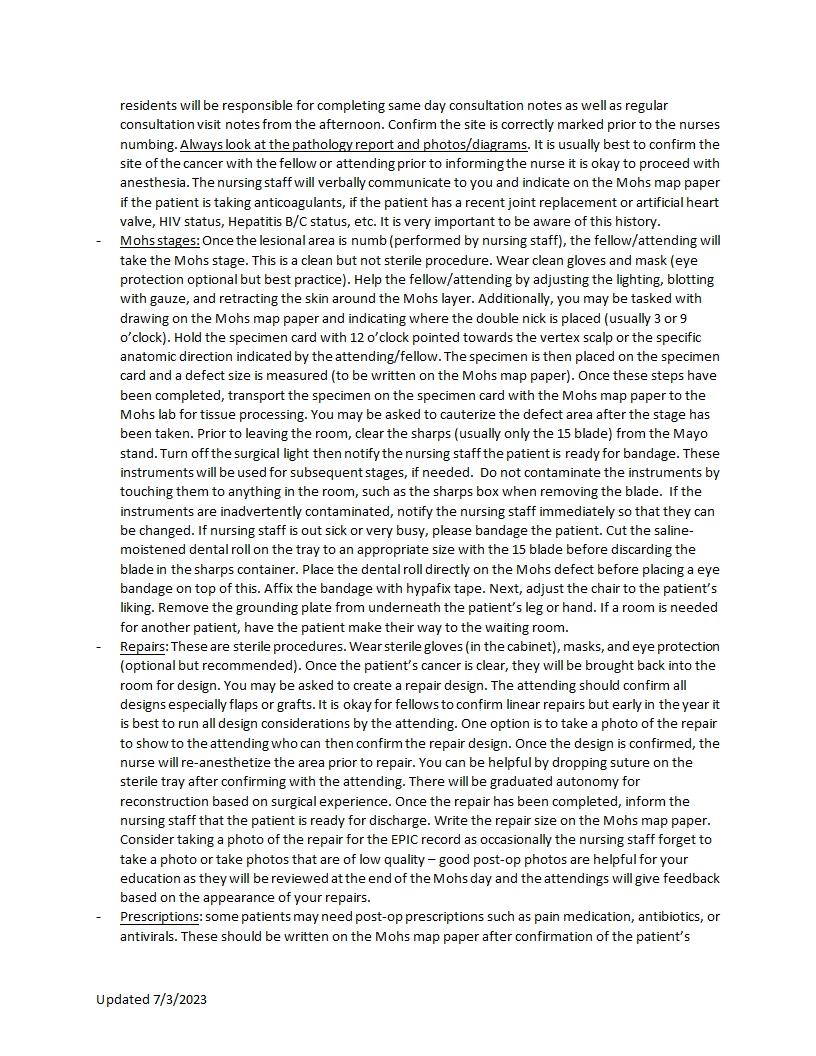
residents will be responsible for completing same day consultation notes as well as regular
consultation visit notes from the afternoon. Confirm the site is correctly marked prior to the nurses
numbing. Always look at the pathology report and photos/diagrams. It is usually best to confirm the
site of the cancer with the fellow or attending prior to informing the nurse it is okay to proceed with
anesthesia. The nursing staff will verbally communicate to you and indicate on the Mohs map paper
if the patient is taking anticoagulants, if the patient has a recent joint replacement or artificial heart
valve, HIV status, Hepatitis B/C status, etc. It is very important to be aware of this history.
- Mohs stages: Once the lesional area is numb (performed by nursing staff), the fellow/attending will
take the Mohs stage. This is a clean but not sterile procedure. Wear clean gloves and mask (eye
protection optional but best practice). Help the fellow/attending by adjusting the lighting, blotting
with gauze, and retracting the skin around the Mohs layer. Additionally, you may be tasked with
drawing on the Mohs map paper and indicating where the double nick is placed (usually 3 or 9
o’clock). Hold the specimen card with 12 o’clock pointed towards the vertex scalp or the specific
anatomic direction indicated by the attending/fellow. The specimen is then placed on the specimen
card and a defect size is measured (to be written on the Mohs map paper). Once these steps have
been completed, transport the specimen on the specimen card with the Mohs map paper to the
Mohs lab for tissue processing. You may be asked to cauterize the defect area after the stage has
been taken. Prior to leaving the room, clear the sharps (usually only the 15 blade) from the Mayo
stand. Turn off the surgical light then notify the nursing staff the patient is ready for bandage. These
instruments will be used for subsequent stages, if needed. Do not contaminate the instruments by
touching them to anything in the room, such as the sharps box when removing the blade. If the
instruments are inadvertently contaminated, notify the nursing staff immediately so that they can
be changed. If nursing staff is out sick or very busy, please bandage the patient. Cut the saline-
moistened dental roll on the tray to an appropriate size with the 15 blade before discarding the
blade in the sharps container. Place the dental roll directly on the Mohs defect before placing a eye
bandage on top of this. Affix the bandage with hypafix tape. Next, adjust the chair to the patient’s
liking. Remove the grounding plate from underneath the patient’s leg or hand. If a room is needed
for another patient, have the patient make their way to the waiting room. - Repairs: These are sterile procedures. Wear sterile gloves (in the cabinet), masks, and eye protection
(optional but recommended). Once the patient’s cancer is clear, they will be brought back into the
room for design. You may be asked to create a repair design. The attending should confirm all
designs especially flaps or grafts. It is okay for fellows to confirm linear repairs but early in the year it
is best to run all design considerations by the attending. One option is to take a photo of the repair
to show to the attending who can then confirm the repair design. Once the design is confirmed, the
nurse will re-anesthetize the area prior to repair. You can be helpful by dropping suture on the
sterile tray after confirming with the attending. There will be graduated autonomy for
reconstruction based on surgical experience. Once the repair has been completed, inform the
nursing staff that the patient is ready for discharge. Write the repair size on the Mohs map paper.
Consider taking a photo of the repair for the EPIC record as occasionally the nursing staff forget to
take a photo or take photos that are of low quality - good post-op photos are helpful for your
education as they will be reviewed at the end of the Mohs day and the attendings will give feedback
based on the appearance of your repairs. - Prescriptions: some patients may need post-op prescriptions such as pain medication, antibiotics, or
antivirals. These should be written on the Mohs map paper after confirmation of the patient’s
Updated 7/3/2023
Page 3
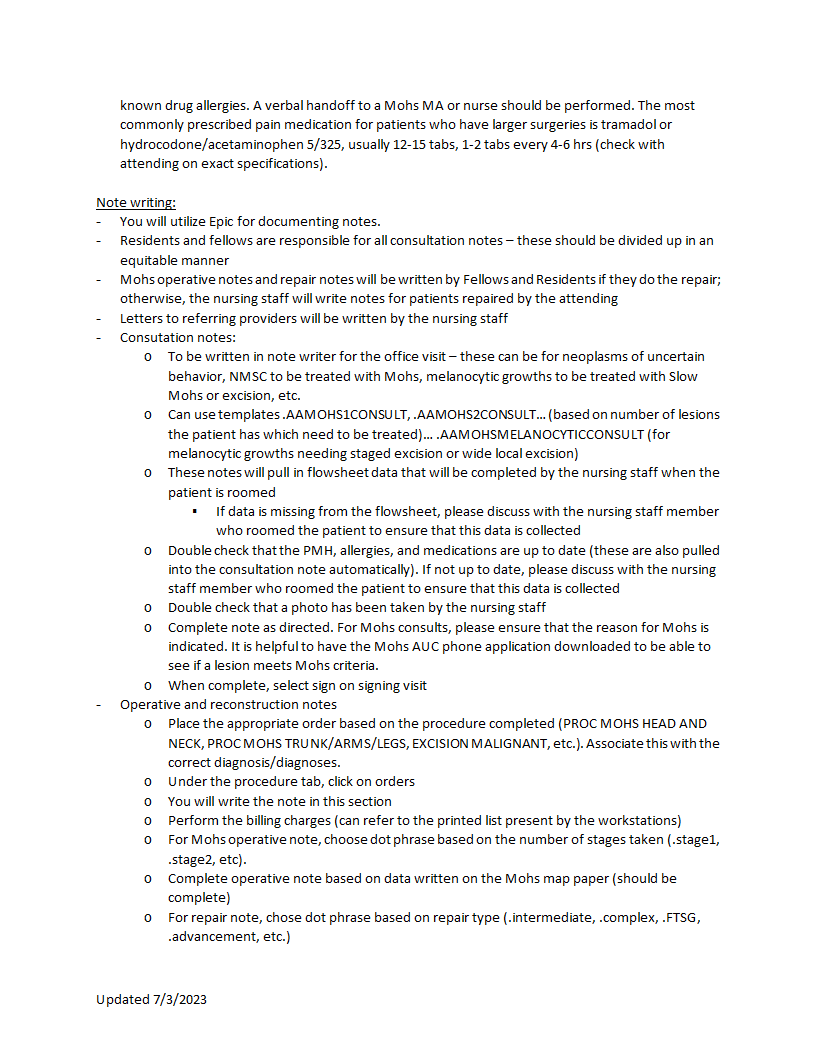
known drug allergies. A verbal handoff to a Mohs MA or nurse should be performed. The most
commonly prescribed pain medication for patients who have larger surgeries is tramadol or
hydrocodone/acetaminophen 5/325, usually 12-15 tabs, 1-2 tabs every 4-6 hrs (check with
attending on exact specifications).
Note writing:
You will utilize Epic for documenting notes.
- Residents and fellows are responsible for all consultation notes - these should be divided up in an
equitable manner - Mohs operative notes and repair notes will be written by Fellows and Residents if they do the repair;
otherwise, the nursing staff will write notes for patients repaired by the attending - Letters to referring providers will be written by the nursing staff
- Consutation notes:
• To be written in note writer for the office visit - these can be for neoplasms of uncertain
behavior, NMSC to be treated with Mohs, melanocytic growths to be treated with Slow
Mohs or excision, etc.
• Can use templates .AAMOHSICONSULT, AAMOHSCONSULT… (based on number of lesions
the patient has which need to be treated)…AAMOHSMELANOCYTICCONSULT (for
melanocytic growths needing staged excision or wide local excision)
• These notes will pull in flowsheet data that will be completed by the nursing staff when the
patient is roomed
• If data is missing from the flowsheet, please discuss with the nursing staff member
who roomed the patient to ensure that this data is collected
• Double check that the PMH, allergies, and medications are up to date (these are also pulled
into the consultation note automatically). If not up to date, please discuss with the nursing
staff member who roomed the patient to ensure that this data is collected
• Double check that a photo has been taken by the nursing staff
• Complete note as directed. For Mohs consults, please ensure that the reason for Mohs is
indicated. It is helpful to have the Mohs AUC phone application downloaded to be able to
see if a lesion meets Mohs criteria.
• When complete, select sign on signing visit - Operative and reconstruction notes
• Place the appropriate order based on the procedure completed (PROC MOHS HEAD AND
NECK, PROC MOHS TRUNK/ARMS/LEGS, EXCISION MALIGNANT, etc.). Associate this with the
correct diagnosis/diagnoses.
• Under the procedure tab, click on orders
• You will write the note in this section
• Perform the billing charges (can refer to the printed list present by the workstations)
• For Mohs operative note, choose dot phrase based on the number of stages taken (stage,
•stage2, etc).
• Complete operative note based on data written on the Mohs map paper (should be
complete
• For repair note, chose dot phrase based on repair type (.intermediate, complex, FTSG,
•advancement, etc.)
Updated 7/3/2023
Page 4
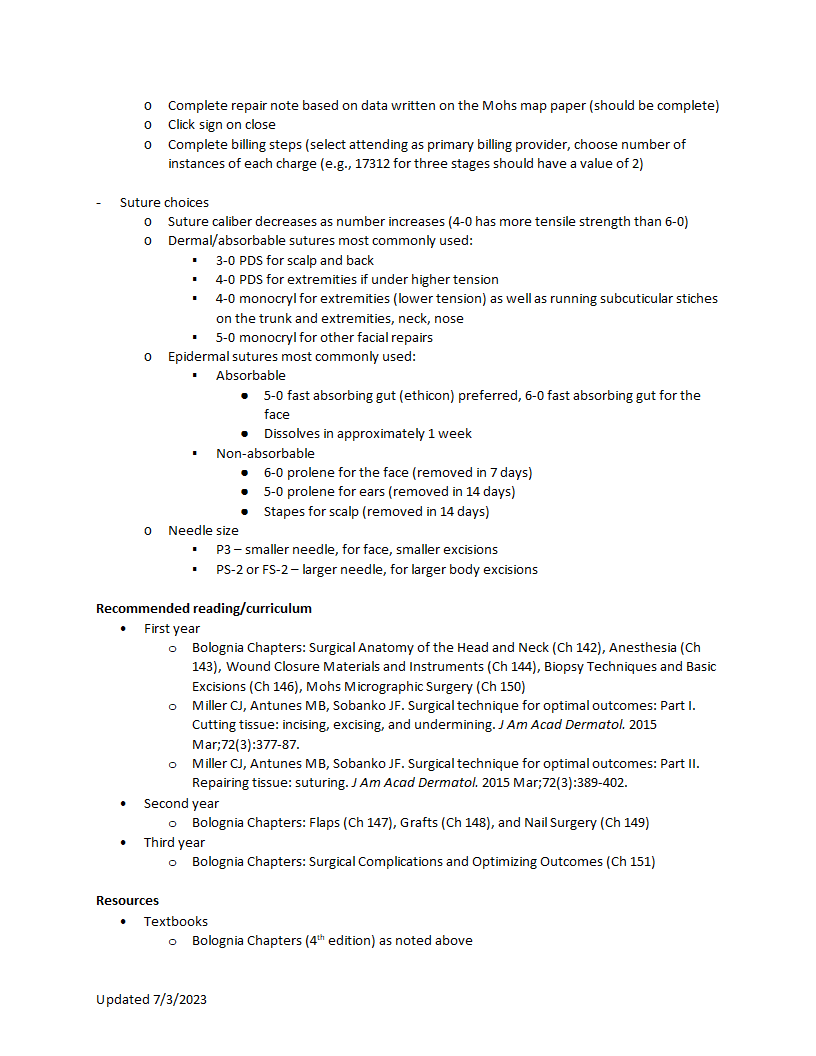
• Complete repair note based on data written on the Mohs map paper (should be complete)
• Click sign on close
• Complete billing steps (select attending as primary billing provider, choose number of
instances of each charge (e.g., 17312 for three stages should have a value of 2)
- Suture choices
Suture caliber decreases as number increases (4-0 has more tensile strength than 6-0)
• Dermal/absorbable sutures most commonly used:
• 3-0 PDS for scalp and back
• 4-0 PDS for extremities if under higher tension
• 4-0 monocryl for extremities (lower tension) as well as running subcuticular stiches
on the trunk and extremities, neck, nose
• 5-0 monocryl for other facial repairs
• Epidermal sutures most commonly used:
• Absorbable
• 5-0 fast absorbing gut (ethicon) preferred, 6-0 fast absorbing gut for the
face
• Dissolves in approximately 1 week
• Non-absorbable
• 6-0 prolene for the face (removed in 7 days)
• 5-0 prolene for ears (removed in 14 days)
• Stapes for scalp (removed in 14 days)
• Needle size
• P3 - smaller needle, for face, smaller excisions
• PS-2 or FS-2 - larger needle, for larger body excisions
Recommended reading/curriculum
• First year
• Bolognia Chapters: Surgical Anatomy of the Head and Neck (Ch 142), Anesthesia (Ch
143), Wound Closure Materials and Instruments (Ch 144), Biopsy Techniques and Basic
Excisions (Ch 146), Mohs Micrographic Surgery (Ch 150)
• Miller CJ, Antunes MB, Sobanko JF. Surgical technique for optimal outcomes: Part I.
Cutting tissue: incising, excising, and undermining. J Am Acad Dermatol. 2015
Mar;72(3):377-87.
• Miller CJ, Antunes MB, Sobanko JF. Surgical technique for optimal outcomes: Part II.
Repairing tissue: suturing. J Am Acad Dermatol. 2015 Mar;72(3):389-402.
• Second year
• Bolognia Chapters: Flaps (Ch 147), Grafts (Ch 148), and Nail Surgery (Ch 149)
• Third year
• Bolognia Chapters: Surgical Complications and Optimizing Outcomes (Ch 151)
Resources
• Textbooks
• Bolognia Chapters (4’” edition) as noted above
Updated 7/3/2023
Page 5
• Online resources
• American Society for Dermatologic Surgery (ASDS.net) website has links to
recommended reading list, online lectures, and journal clubs. The Dermatologic Surgery
Fundamentals lecture series is an excellent resource, particularly for first-year residents.
• American Academy of Dermatology (AAD) Dialogues in Dermatology podcast series is
complementary to residents and contains surgical, general dermatological, and practice
management content
• The American College of Mohs Surgery offers a monthly online journal club. To be
included in the invitation email, please contact Kira Burk at [email protected].
Updated 7/3/2023