General Dermatology PGY-4
Inserted document · 3 pages · click any page to read
Text from this document (searchable)
Page 1
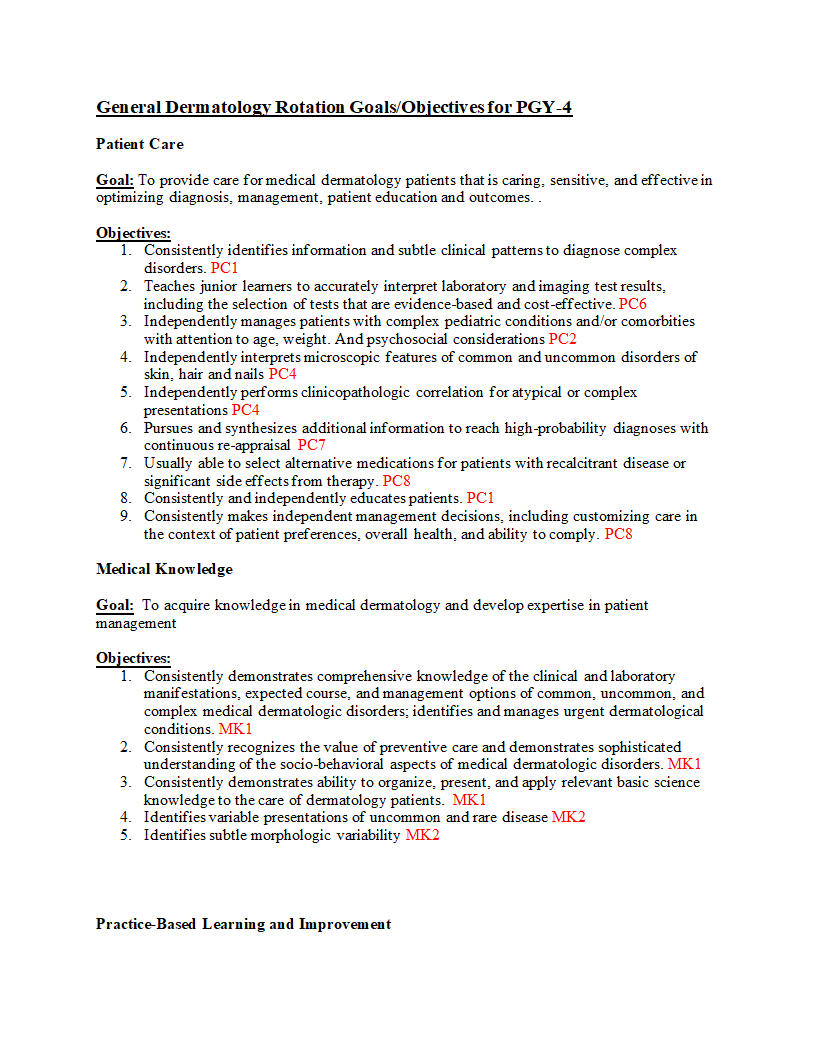
General Dermatology Rotation Goals/Objectives for PGY-4
Patient Care
Goal: To provide care for medical dermatology patients that is caring, sensitive, and effective in
optimizing diagnosis, management, patient education and outcomes.
Objectives:
- Consistently identifies information and subtle clinical patterns to diagnose complex
disorders. PC1 - Teaches junior learners to accurately interpret laboratory and imaging test results,
including the selection of tests that are evidence-based and cost-effective. PC6 - Independently manages patients with complex pediatric conditions and/or comorbities
with attention to age, weight. And psychosocial considerations PC2 - Independently interprets microscopic features of common and uncommon disorders of
skin, hair and nails PC4 - Independently performs clinicopathologic correlation for atypical or complex
presentations PC4 - Pursues and synthesizes additional information to reach high-probability diagnoses with
continuous re-appraisal PC7 - Usually able to select alternative medications for patients with recalcitrant disease or
significant side effects from therapy. PC8 - Consistently and independently educates patients. PC1
- Consistently makes independent management decisions, including customizing care in
the context of patient preferences, overall health, and ability to comply. PCS
Medical Knowledge
Goal: To acquire knowledge in medical dermatology and develop expertise in patient
management
Objectives: - Consistently demonstrates comprehensive knowledge of the clinical and laboratory
manifestations, expected course, and management options of common, uncommon, and
complex medical dermatologic disorders; identifies and manages urgent dermatological
conditions. MK1 - Consistently recognizes the value of preventive care and demonstrates sophisticated
understanding of the socio-behavioral aspects of medical dermatologic disorders. MK1 - Consistently demonstrates ability to organize, present, and apply relevant basic science
knowledge to the care of dermatology patients. MK1 - Identifies variable presentations of uncommon and rare disease MK2
- Identifies subtle morphologic variability MK2
Practice-Based Learning and Improvement
Page 2
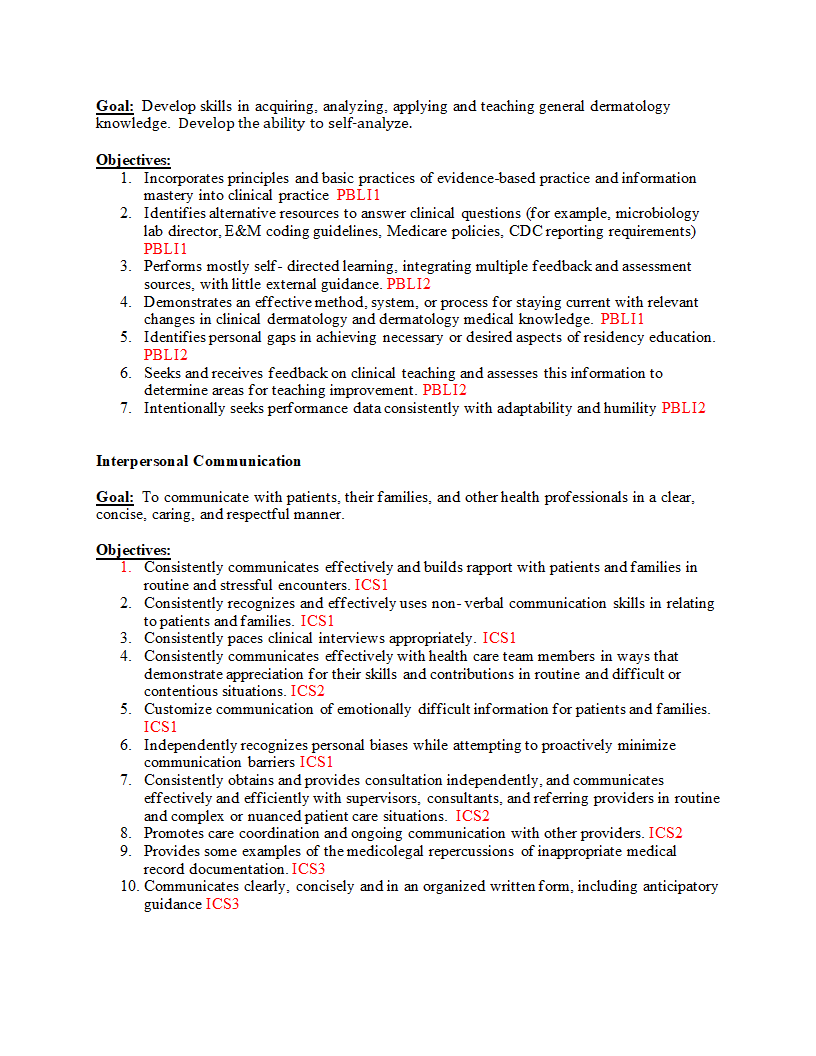
Goal: Develop skills in acquiring, analyzing, applying and teaching general dermatology
knowledge. Develop the ability to self-analyze.
Objectives:
- Incorporates principles and basic practices of evidence-based practice and information
mastery into clinical practice PBLI1 - Identifies alternative resources to answer clinical questions (for example, microbiology
lab director, E&M coding guidelines, Medicare policies, CDC reporting requirements)
PBLI1 - Performs mostly self- directed learning, integrating multiple feedback and assessment
sources, with little external guidance. PBLI2 - Demonstrates an effective method, system, or process for staying current with relevant
changes in clinical dermatology and dermatology medical knowledge. PBLI1 - Identifies personal gaps in achieving necessary or desired aspects of residency education.
PBLI2 - Seeks and receives feedback on clinical teaching and assesses this information to
determine areas for teaching improvement. PBLI2 - Intentionally seeks performance data consistently with adaptability and humility PBLI2
Interpersonal Communication
Goal: To communicate with patients, their families, and other health professionals in a clear,
concise, caring, and respectful manner.
Objectives: - Consistently communicates effectively and builds rapport with patients and families in
routine and stressful encounters. ICS1 - Consistently recognizes and effectively uses non-verbal communication skills in relating
to patients and families. ICS1 - Consistently paces clinical interviews appropriately. ICS1
- Consistently communicates effectively with health care team members in ways that
demonstrate appreciation for their skills and contributions in routine and difficult or
contentious situations. ICS2 - Customize communication of emotionally difficult information for patients and families.
ICS1 - Independently recognizes personal biases while attempting to proactively minimize
communication barriers ICS1 - Consistently obtains and provides consultation independently, and communicates
effectively and efficiently with supervisors, consultants, and referring providers in routine
and complex or nuanced patient care situations. ICS2 - Promotes care coordination and ongoing communication with other providers. ICS2
- Provides some examples of the medicolegal repercussions of inappropriate medical
record documentation. ICS3 - Communicates clearly, concisely and in an organized written form, including anticipatory
guidance ICS
Page 3
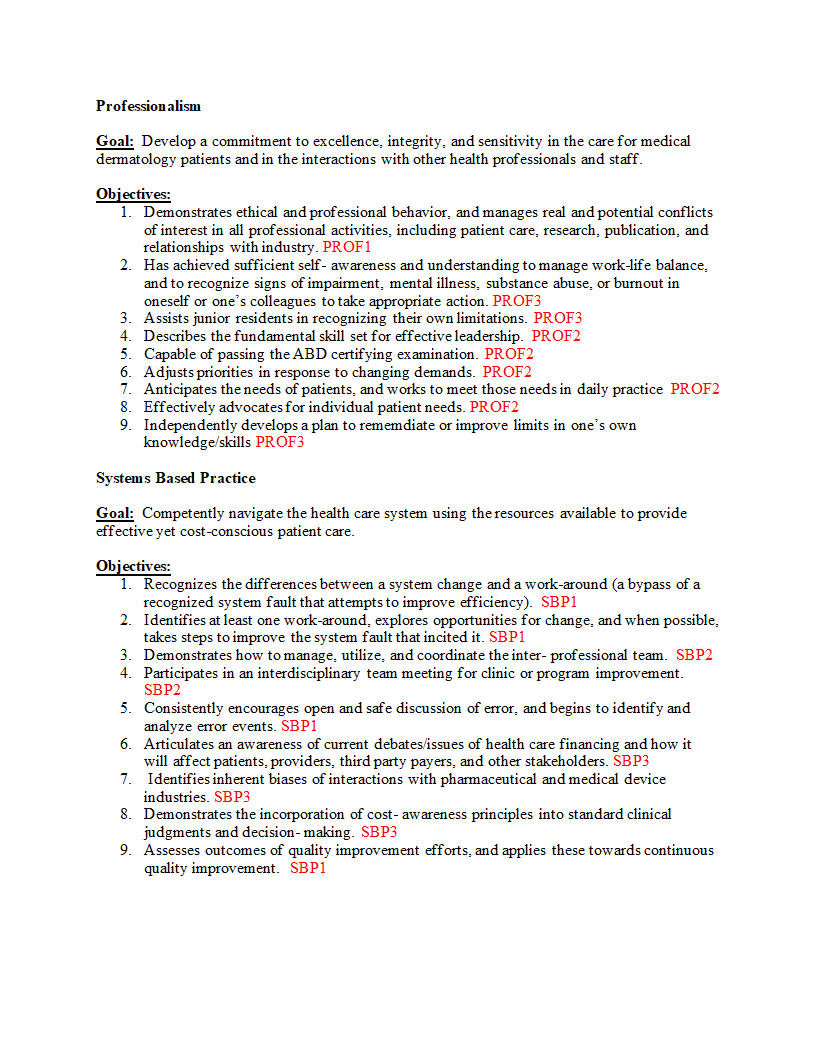
Profession alism
Goal: Develop a commitment to excellence, integrity, and sensitivity in the care for medical
dermatology patients and in the interactions with other health professionals and staff.
Objectives:
- Demonstrates ethical and professional behavior, and manages real and potential conflicts
of interest in all professional activities, including patient care, research, publication, and
relationships with industry. PROF1 - Has achieved sufficient self - awareness and understanding to manage work-life balance,
and to recognize signs of impairment, mental illness, substance abuse, or burnout in
oneself or one’s colleagues to take appropriate action. PROF3 - Assists junior residents in recognizing their own limitations. PROF3
- Describes the fundamental skill set for effective leadership. PROF2
- Capable of passing the ABD certifying examination. PROF2
- Adjusts priorities in response to changing demands. PROF2
- Anticipates the needs of patients, and works to meet those needs in daily practice PROF2
- Effectively advocates for individual patient needs. PROF2
- Independently develops a plan to rememdiate or improve limits in one’s own
knowledge/skills PROF3
Systems Based Practice
Goal: Competently navigate the health care system using the resources available to provide
effective yet cost-conscious patient care.
Objectives: - Recognizes the differences between a system change and a work-around (a bypass of a
recognized system fault that attempts to improve efficiency). SBP1 - Identifies at least one work-around, explores opportunities for change, and when possible,
takes steps to improve the system fault that incited it. SBP1 - Demonstrates how to manage, utilize, and coordinate the inter- professional team. SBP2
- Participates in an interdisciplinary team meeting for clinic or program improvement.
SBP2 - Consistently encourages open and safe discussion of error, and begins to identify and
analyze error events. SBP1 - Articulates an awareness of current debates/issues of health care financing and how it
will affect patients, providers, third party payers, and other stakeholders. SBP3 - Identifies inherent biases of interactions with pharmaceutical and medical device
industries. SBP3 - Demonstrates the incorporation of cost- awareness principles into standard clinical
judgments and decision- making. SBP3 - Assesses outcomes of quality improvement efforts, and applies these towards continuous
quality improvement. SBP1