Mohs and Cutaneous Oncology PGY-3
Text from this document (searchable)
Page 1
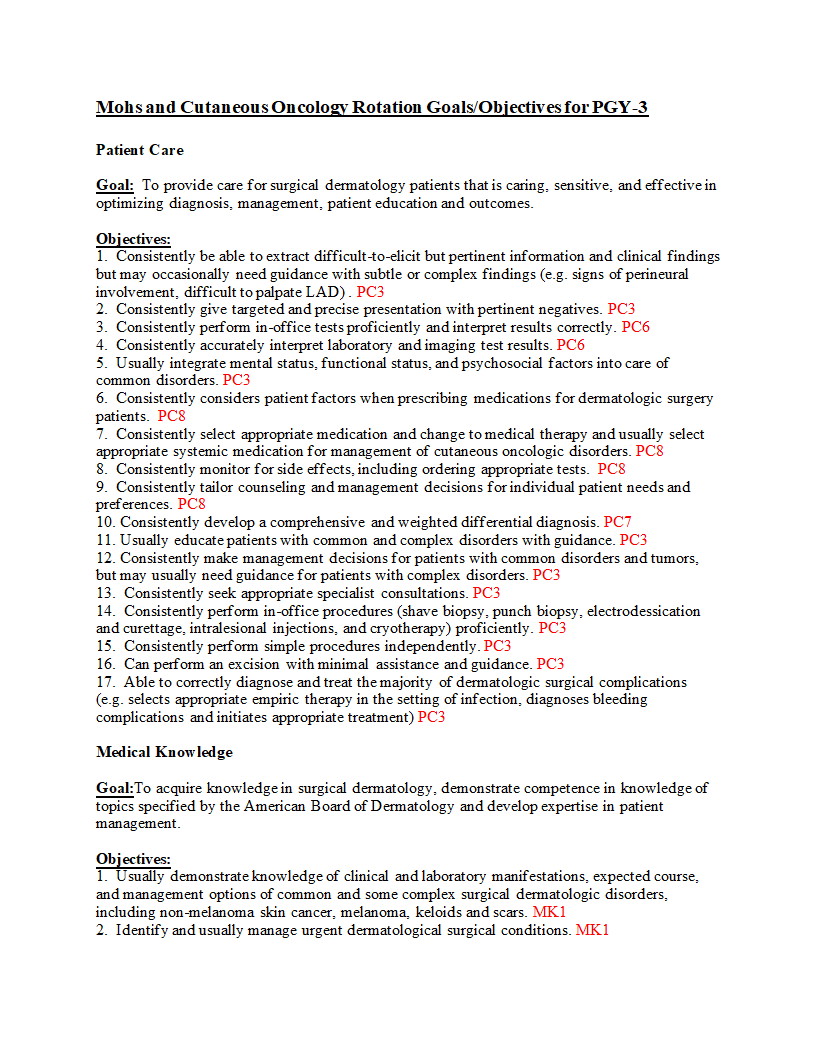
Mohs and Cutaneous Oncology Rotation Goals/Objectives for PGY-3
Patient Care
Goal: To provide care for surgical dermatology patients that is caring, sensitive, and effective in
optimizing diagnosis, management, patient education and outcomes.
Objectives:
- Consistently be able to extract difficult-to-elicit but pertinent information and clinical findings
but may occasionally need guidance with subtle or complex findings (e.g. signs of perineural
involvement, difficult to palpate LAD). PC3 - Consistently give targeted and precise presentation with pertinent negatives. PC3
- Consistently perform in-office tests proficiently and interpret results correctly. PC6
- Consistently accurately interpret laboratory and imaging test results. PC6
- Usually integrate mental status, functional status, and psychosocial factors into care of
common disorders. PC3 - Consistently considers patient factors when prescribing medications for dermatologic surgery
patients. PC8 - Consistently select appropriate medication and change to medical therapy and usually select
appropriate systemic medication for management of cutaneous oncologic disorders. PC8 - Consistently monitor for side effects, including ordering appropriate tests. PC8
- Consistently tailor counseling and management decisions for individual patient needs and
preferences. PC8 - Consistently develop a comprehensive and weighted differential diagnosis. PC7
- Usually educate patients with common and complex disorders with guidance. PC
- Consistently make management decisions for patients with common disorders and tumors,
but may usually need guidance for patients with complex disorders. PC3 - Consistently seek appropriate specialist consultations. PC3
- Consistently perform in-office procedures (shave biopsy, punch biopsy, electrodessication
and curettage, intralesional injections, and cryotherapy) proficiently. PC3 - Consistently perform simple procedures independently. PC3
- Can perform an excision with minimal assistance and guidance. PC3
- Able to correctly diagnose and treat the majority of dermatologic surgical complications
(eg. selects appropriate empiric therapy in the setting of infection, diagnoses bleeding
complications and initiates appropriate treatment) PC3
Medical Knowledge
Goal:To acquire knowledge in surgical dermatology, demonstrate competence in knowledge of
topics specified by the American Board of Dermatology and develop expertise in patient
management.
Jbjectives: - Usually demonstrate knowledge of clinical and laboratory manifestations, expected course
and management options of common and some complex surgical dermatologic disorders,
including non-melanoma skin cancer, melanoma, keloids and scars. MK1 - Identify and usually manage urgent dermatological surgical conditions. MK1
Page 2
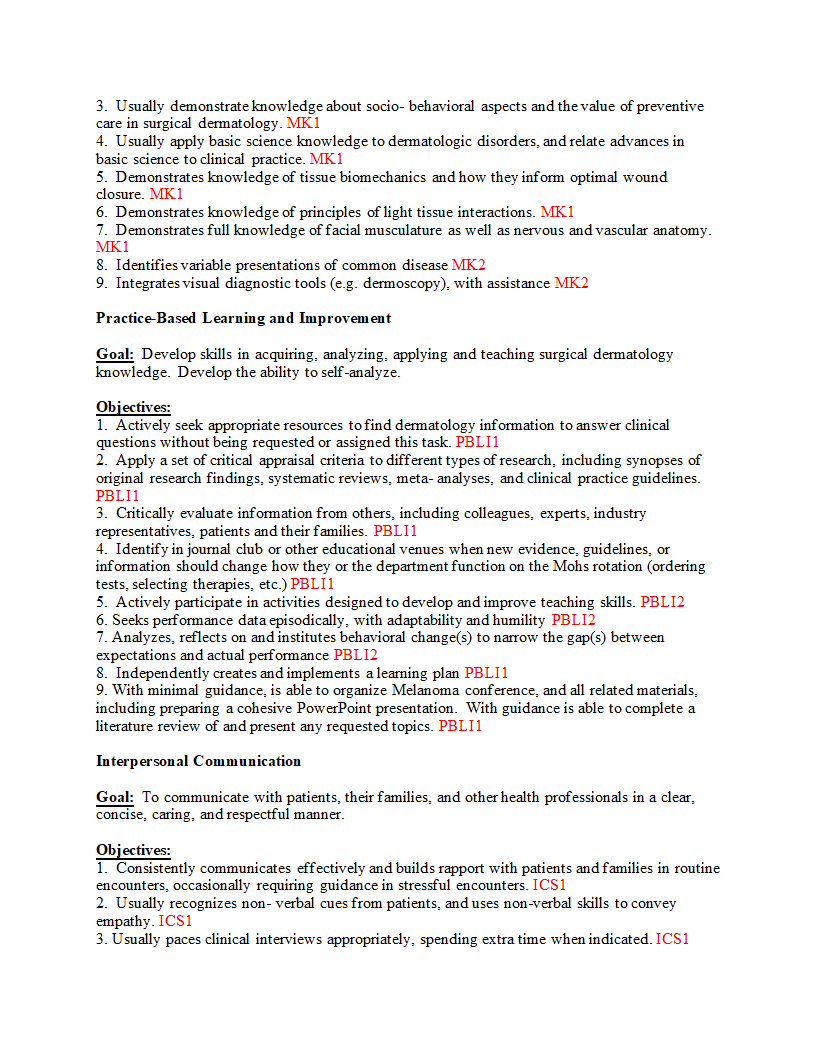
3. Usually demonstrate knowledge about socio- behavioral aspects and the value of preventive
care in surgical dermatology. MK1
4. Usually apply basic science knowledge to dermatologic disorders, and relate advances in
basic science to clinical practice. MK1
5. Demonstrates knowledge of tissue biomechanics and how they inform optimal wound
closure. MK1
6. Demonstrates knowledge of principles of light tissue interactions. MK1
7. Demonstrates full knowledge of facial musculature as well as nervous and vascular anatomy.
MK1
8. Identifies variable presentations of common disease MK2
9. Integrates visual diagnostic tools (eg. dermoscopy), with assistance MK2
Practice-Based Learning and Improvement
Goal: Develop skills in acquiring, analyzing, applying and teaching surgical dermatology
knowledge. Develop the ability to self-analyze.
Objectives:
- Actively seek appropriate resources to find dermatology information to answer clinical
questions without being requested or assigned this task. PBLI1 - Apply a set of critical appraisal criteria to different types of research, including synopses of
original research findings, systematic reviews, meta- analyses, and clinical practice guidelines.
PBLI1 - Critically evaluate information from others, including colleagues, experts, industry
representatives, patients and their families. PBLI1 - Identify in journal club or other educational venues when new evidence, guidelines, or
information should change how they or the department function on the Mohs rotation (ordering
tests, selecting therapies, etc.) PBLI1 - Actively participate in activities designed to develop and improve teaching skills. PBLI2
- Seeks performance data episodically, with adaptability and humility PBLI2
- Analyzes, reflects on and institutes behavioral changes) to narrow the gap(s) between
expectations and actual performance PBLI2 - Independently creates and implements a learning plan PBLI1
- With minimal guidance, is able to organize Melanoma conference, and all related materials,
including preparing a cohesive PowerPoint presentation. With guidance is able to complete a
literature review of and present any requested topics. PBLI1
Interpersonal Communication
Goal: To communicate with patients, their families, and other health professionals in a clear,
concise, caring, and respectful manner.
Objectives: - Consistently communicates effectively and builds rapport with patients and families in routine
encounters, occasionally requiring guidance in stressful encounters. ICS1 - Usually recognizes non- verbal cues from patients, and uses non-verbal skills to convey
empathy. ICS1 - Usually paces clinical interviews appropriately, spending extra time when indicated. ICS1
Page 3
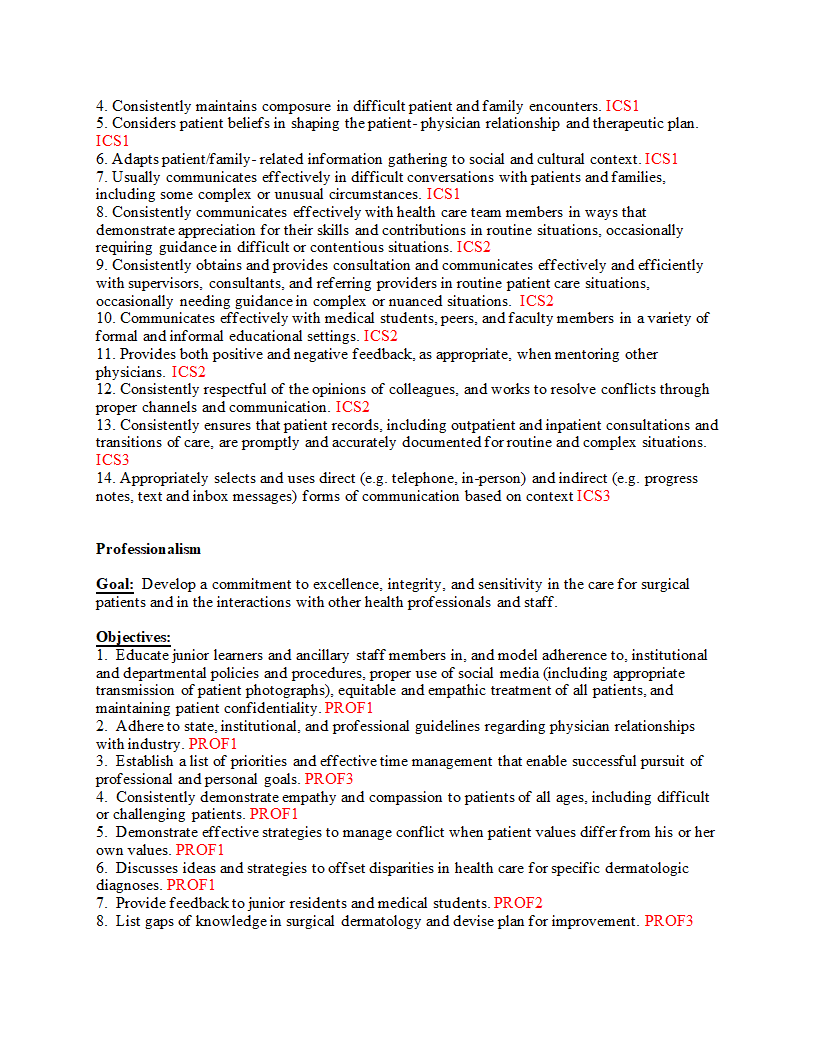
4. Consistently maintains composure in difficult patient and family encounters. ICS1
5. Considers patient beliefs in shaping the patient- physician relationship and therapeutic plan.
ICS1
6. Adapts patient/family- related information gathering to social and cultural context. ICS1
7. Usually communicates effectively in difficult conversations with patients and families.
including some complex or unusual circumstances. ICS1
8. Consistently communicates effectively with health care team members in ways that
demonstrate appreciation for their skills and contributions in routine situations, occasionally
requiring guidance in difficult or contentious situations. ICS2
9. Consistently obtains and provides consultation and communicates effectively and efficiently
with supervisors, consultants, and referring providers in routine patient care situations.
occasionally needing guidance in complex or nuanced situations. ICS2
10. Communicates effectively with medical students, peers, and faculty members in a variety of
formal and informal educational settings. ICS2
11. Provides both positive and negative feedback, as appropriate, when mentoring other
physicians. ICS2
12. Consistently respectful of the opinions of colleagues, and works to resolve conflicts through
proper channels and communication. ICS2
13. Consistently ensures that patient records, including outpatient and inpatient consultations and
transitions of care, are promptly and accurately documented for routine and complex situations.
ICS3
14. Appropriately selects and uses direct (e.g. telephone, in-person) and indirect (e.g. progress
notes, text and inbox messages) forms of communication based on context ICS3
Professionalism
Goal: Develop a commitment to excellence, integrity, and sensitivity in the care for surgical
patients and in the interactions with other health professionals and staff.
Objectives:
- Educate junior learners and ancillary staff members in, and model adherence to, institutional
and departmental policies and procedures, proper use of social media (including appropriate
transmission of patient photographs), equitable and empathic treatment of all patients, and
maintaining patient confidentiality. PROFI - Adhere to state, institutional, and professional guidelines regarding physician relationships
with industry. PROF1 - Establish a list of priorities and effective time management that enable successful pursuit of
professional and personal goals. PROF3 - Consistently demonstrate empathy and compassion to patients of all ages, including difficult
or challenging patients. PROFI - Demonstrate effective strategies to manage conflict when patient values differ from his or her
own values. PROF1 - Discusses ideas and strategies to offset disparities in health care for specific dermatologic
diagnoses. PROF1 - Provide feedback to junior residents and medical students. PROF2
- List gaps of knowledge in surgical dermatology and devise plan for improvement. PROF3
Page 4
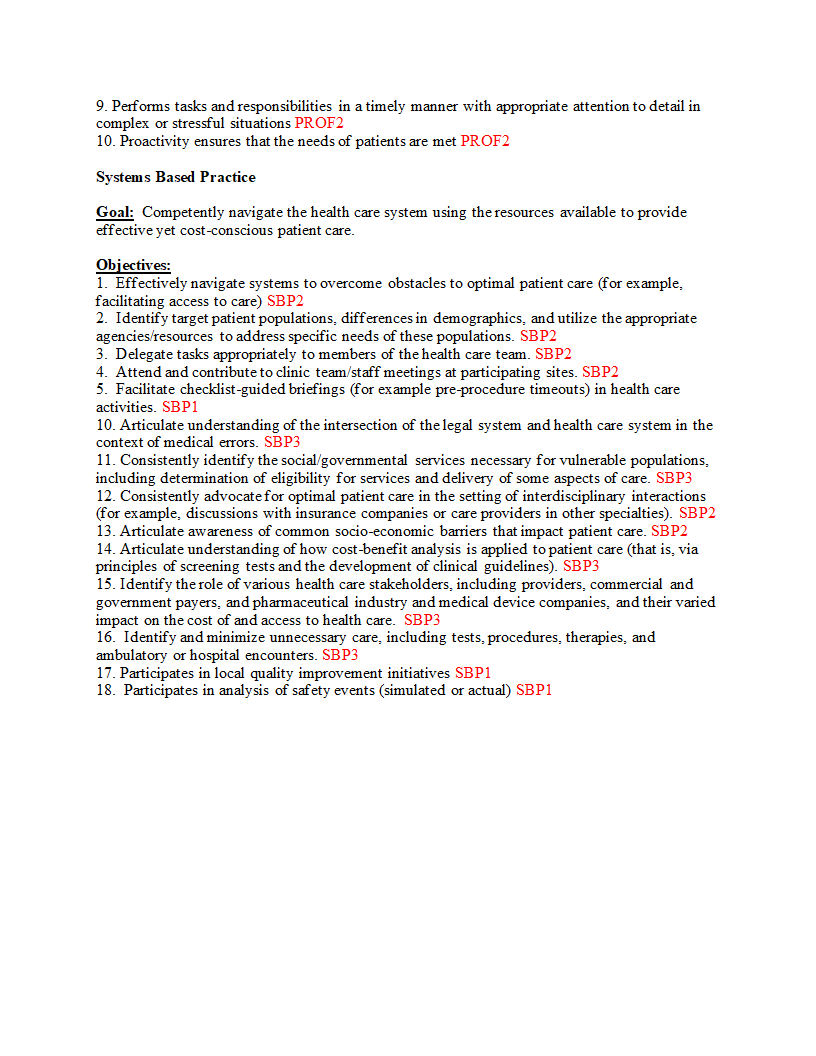
9. Performs tasks and responsibilities in a timely manner with appropriate attention to detail in
complex or stressful situations PROF2
10. Proactivity ensures that the needs of patients are met PROF2
Systems Based Practice
Goal: Competently navigate the health care system using the resources available to provide
effective yet cost-conscious patient care.
Objectives:
- Effectively navigate systems to overcome obstacles to optimal patient care (for example.
facilitating access to care) SBP2 - Identify target patient populations, differences in demographics, and utilize the appropriate
agencies/resources to address specific needs of these populations. SBP2 - Delegate tasks appropriately to members of the health care team. SBP2
- Attend and contribute to clinic team/staff meetings at participating sites. SBP2
- Facilitate checklist-guided briefings (for example pre-procedure timeouts) in health care
activities. SBP1 - Articulate understanding of the intersection of the legal system and health care system in the
context of medical errors. SBP3 - Consistently identify the social/governmental services necessary for vulnerable populations,
including determination of eligibility for services and delivery of some aspects of care. SBP3 - Consistently advocate for optimal patient care in the setting of interdisciplinary interactions
(for example, discussions with insurance companies or care providers in other specialties). SBP2 - Articulate awareness of common socio-economic barriers that impact patient care. SBP2
- Articulate understanding of how cost-benefit analysis is applied to patient care (that is, via
principles of screening tests and the development of clinical guidelines). SBP3 - Identify the role of various health care stakeholders, including providers, commercial and
government payers, and pharmaceutical industry and medical device companies, and their varied
impact on the cost of and access to health care. SBP3 - Identify and minimize unnecessary care, including tests, procedures, therapies, and
ambulatory or hospital encounters. SBP3 - Participates in local quality improvement initiatives SBP1
- Participates in analysis of safety events (simulated or actual) SBP1