Code of Professional Conduct
Addressing Violations
Violations of the Code—ranging from harassment to falsification of records—are taken seriously. A structured process is in place for reporting, investigating, and resolving concerns, with support from the Office of Professional Oversight (OPO) and the Designated Institutional Official (DIO).
Text from this document (searchable)
Page 1
III.
The Code of Professional Conduct for Housestaff is not intended to dictate behavior. It
does, however, establish minimum expectations which provide a disciplinary framework
for those who choose not to abide by these professional standards, and it serves to remind
everyone that a procedural framework for enforcing the Code is in place.
The Code of Professional Conduct for Housestaff
”While serving as a resident or fellow, and member of the profession of medicine,
I will
conduct myself at all times and in all places with competence, integrity, honesty, and
candor. I promise to those whose care I am entrusted, a personal commitment to their best
interests, compassion, and absolute discretion and confidentiality.
I shall treat my patients as I would expect to be treated, obtaining consultation when
they desire or I believe there is a need, including them to the extent possible in all
important decisions, and helping to decrease suffering when cure is not attainable,
recognizing that a dignified death is important in everyone’s life.
I shall accept all patients in a non-judgmental manner, respecting the full human dignity
of each individual regardless of their value system. I shall respect the rights and dignity
of all individuals. I promise to attend to my own physical, mental, intellectual, and
spiritual development in the best interest of serving others.
Expectations
The following statements, further describe minimum expectations for housestaff
professional behavior.
A. Respect for all individuals in the SSM Health/SLUSOM community.
Housestaff, students, faculty, and staff recognize the right of all individuals to be
treated with respect without regard to position, race, age, gender, disability,
national origin, religion, sexual orientation, color, marital status, military status,
veteran’s status, or any other characteristic that is protected by law.
Sexual harassment is prohibited by Title VII of the Civil Rights Act of 1964 and
by Title IX of the Education Amendments of 1972. The SSM Health shall take
reasonable steps to prevent sexual harassment from occurring (Policy: Sexual and
Other Harassment v.3)
B. Appropriate handling of information, records, or examination materials.
Any form of cheating or providing false or misleading information is a violation
of the trust placed in physicians and is a serious infraction of the Code of
Professional Conduct.
Patients’ records must be accurate and legible. Timely and accurate completion of
medical records according to specific guidelines of the affiliated institution at
which the resident is rotating is mandatory.
Patients’ records must only be accessed in order to fulfill professional
responsibilities to that patient. SSM Health/SLUSOM policy prohibits accessing
one’s own medical record, or the medical record of friends and family members.
C. Respect for patients’ confidentiality and safety.
Patients’ privacy, modesty, and confidentiality must always be honored. Patients
Page 2
must be treated with kindness, gentleness, dignity, empathy, and compassion.
Patients’ protected health information should not be accessed or shared with
anyone not involved in their care without adequate justification or permission.
Patients’ information, identifiable or not, and in any format whether it is text,
images, audio, or video should not be publicly disseminated, including through
social media.
D. Proper deportment as a medical professional.
Appearance, speech, and behavior should be above reproach during patient care
activities. Identification badges issued by SSM Health/SLUSOM and by
affiliated hospitals should be clearly displayed at all times. Dress should be
appropriate for professional activities, and personal hygiene should be exemplary.
Professional use of SSM Health/SLUSOM social media sites must comply with
SSM Health policies. Use of personal social media sites must be conducted with a
personal email during non-working hours. Social media content must not contain
confidential or proprietary information about SSM Health/SLUSOM, its
students, employees, or patients. There is no expectation of privacy when using
social media. Unprofessional postings may damage personal reputation and
impact professional success. Possession or use of stimulants, depressants,
narcotics, or hallucinogenic drugs and other agents having potential for abuse,
except on a physician’s or dentist’s prescription, are forbidden by SSM
Health/SL.USOM policy and local, state, and federal law. Such conduct is
prohibited on SSM Health premises or as part of any employment activities. The
selling, bartering, exchanging, or giving away of such drugs to any person is
illegal and prohibited. Housestaff engaged in the use of illegal substances will be
subject to arrest by law enforcement agents and will seriously jeopardize their
status as housestaff at SSM Health. (Policy: Drug and Alcohol Free Workplace v.5)
E. Respect for laws, policies, and regulations.
Residents and fellows are expected to recognize that laws are established for the
benefit of society as a whole. Specific rules, policies, and regulations have been
established for the benefit of the SSM Health/SLUSOM community. Laws,
policies, and regulations are not to be disregarded or violated
F. Respect for property, the learning environment, and instructional material.
All property, learning spaces, and instructional material must be respected.
Educational resources should be used equitably. Respect for all learners and
teachers will be demonstrated at all times. Housestaff will abide by the
educational processes designed for the clinical supervision, teaching, and learning
within SSM Health/SLUSOM and its affiliated sites. Bullying, harassment, and
demeaning actions or behaviors will not be tolerated in the learning environment.
IV.
Code Violations
A violation of the Code of Professional Conduct occurs when any housestaff acts
contrary to the values and responsibilities expected of those engaged in the profession of
medicine. Violations occur when any resident jeopardizes the welfare of a patient,
disregards the rights or dignity of another individual, or allows or assists another in so
doing
Page 3
V.
Appendix A lists examples of unacceptable behavior under each category of expectations.
SSM Health/SLUSOM reserves the right to initiate action and impose sanctions for any
conduct that is not specifically listed in Appendix A, but is determined to be a violation
of the Code, regardless of whether the violation occurs on or off the premises of SSM
Health/SLUSOM.
Procedures for Investigating and Taking Action to Remedy Code Violations
SSM Health/SLUSOM has a responsibility to ensure a professional environment and to
provide equity for all parties involved in a breach of professional conduct. Therefore,
SSM Health/SLUSOM has adopted procedures to respond to infractions of the
Professional Conduct Code. Individuals reporting an infraction of the Code can first
speak with offenders about the infraction and remind them of their professional conduct.
If circumstances do not allow the claimant to approach the offender, or the claimant
believes the alleged infraction requires further action, the allegation may be referred to
the GME Ombuds.
The Office of Professional Oversight or OPO helps faculty, students, and staff resolve
University related conflicts. The OPO seeks to ensure that all members of the SSM
Health/SLUSOM community receive fair and equitable treatment. The OPO’s concern is
to bring to the attention of responsible administrators those problems which persist and
which should be corrected. The OPO functions independently and is neutral, impartial,
and confidential. Office of Professional Oversight: SLU - Saint Louis University
Allegations not resolved by the OPO, or of sufficient seriousness, may be referred to
SSM Health human resources or the Designated Institutional Official (DIO) for further
consideration via the Grievance and Due Process Policy. PP 2.1 Operation Res &
Fell.doc. As the institutional sponsor for accreditation, the DIO has the final decision on
educational actions on behalf of SSM Health/SLUSOM. As the employer of record for all
trainees, the employment decision of SSM Health HR regarding these infractions is final.
APPENDIX A
Examples of Unacceptable Behaviors
Per Section ILA-F
A. Respect for all individuals in the SSM Health/SLUSOM learning environment.
Unacceptable behaviors include (but are not limited to):
• expressing racial, sexual, sexist, or religious slurs
• committing racial or sexual harassment
• using inappropriate, offensive or threatening language
• committing physical acts of violence or threats of violence
• not shouldering a fair share of the educational team responsibility
• manipulating clinical schedules for one’s own benefit by any means
• causing or encouraging disruptions during educational sessions
• showing lack of respect to educators, technicians, other professionals, and support
staff
Page 4
• failing to comply with a reasonable request or instruction from faculty, staff, or
administrators
• failure to respond, in a timely manner, to a departmental consulting request
• using computer e-mail or internet in a harassing or libelous manner
• using social media in a way contrary to the policies of SSM Health/SLUSOM
B. Appropriate handling of information, records, or examination of materials.
Unacceptable behaviors include (but are not limited to):
• giving or receiving any information except as allowed by the course director or
teaching faculty during the course of an exam
• plagiarizing, forging, or falsifying patient records, research, scientific data,
academic records, or financial aid information
• tampering with test material, or dishonesty in connection with an examination
• abusing computerized information or technology
• failure to complete patient care documentation accurately or in a timely manner
• falsifying or defacing transcripts, evaluation forms, or other official documents
Respect for patients’ confidentiality and safety
Unacceptable behaviors include (but are not limited to):
• failing to ask for assistance from appropriate faculty or staff when needed
• writing offensive or inappropriate comments in the patient’s chart
• sharing medical or personal details of a patient with anyone other than health
professionals who need the information for the patient’s care
• using, posting, publishing, or capturing patient images or information without
proper permission
• engaging in discussion about a patient in public areas
• using your professional position in accessing medical or personal details about a
patient, a faculty member, student, staff member, or another resident or fellow, or
any other person for reasons other than provision of care.
Proper presentation as a medical professional.
Unacceptable behaviors include (but are not limited to):
• inducing or allowing the patient or others to believe ones’ status as a resident or
fellow is other than it is
• exhibiting personal appearance that give the impression of uncleanliness or
carelessness
• failing to maintain professional composure during stressful circumstances
• engaging in an inappropriate relationship with patients or their family members
• using alcohol, drugs, or other substances inappropriately or excessively, or in a
way that could affect the quality of patient care, on call duties, or academic
performance.
E.
Respect for laws, policies, and regulations.
Unacceptable behaviors include (but are not limited to):
Page 5
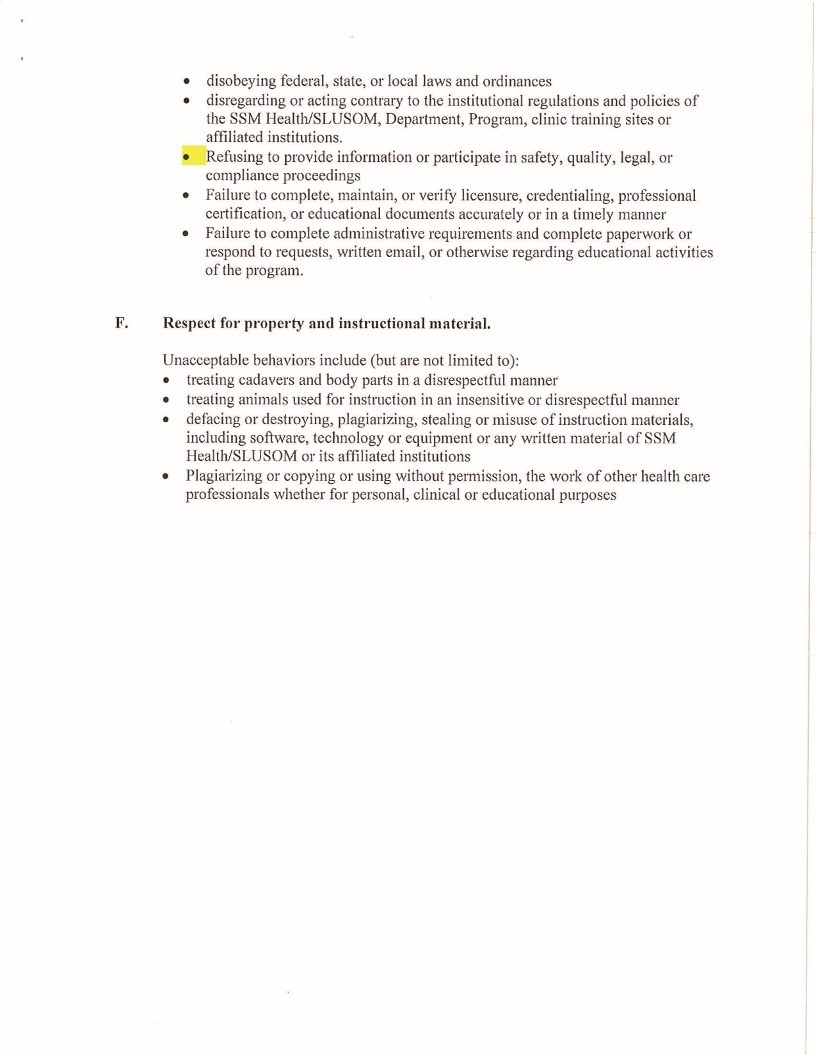
• disobeying federal, state, or local laws and ordinances
• disregarding or acting contrary to the institutional regulations and policies of
the SSM Health/SLUSOM, Department, Program, clinic training sites or
affiliated institutions.
Refusing to provide information or participate in safety, quality, legal, or
compliance proceedings
• Failure to complete, maintain, or verify licensure, credentialing, professional
certification, or educational documents accurately or in a timely manner
• Failure to complete administrative requirements and complete paperwork or
respond to requests, written email, or otherwise regarding educational activities
of the program.
Respect for property and instructional material.
Unacceptable behaviors include (but are not limited to):
• treating cadavers and body parts in a disrespectful manner
• treating animals used for instruction in an insensitive or disrespectful manner
• defacing or destroying, plagiarizing, stealing or misuse of instruction materials,
including software, technology or equipment or any written material of SSM
Health/SLUSOM or its affiliated institutions
• Plagiarizing or copying or using without permission, the work of other health care
professionals whether for personal, clinical or educational purposes